

- This event has passed.
Rienzi in HD
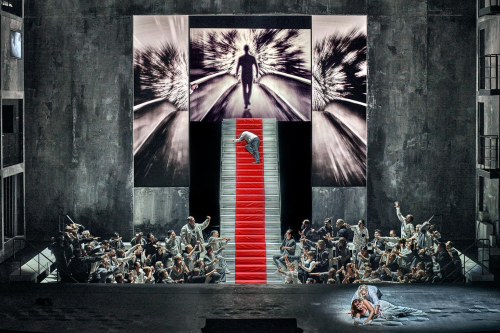
Rienzi, Wagner’s third opera, was once his greatest success. The story of the Roman tribune combines rise and fall, private tragedy and public vision. The original score is considered lost. This rarely performed work serves as a link between Grand Opéra and music drama, with orchestral power and emotional depth. This HD screening of the performance in Bayreuth is a unique opportunity to rediscover Wagner’s early triumph – where it has never been heard before.
Date & Venue Change: The screening will happen only on Monday, 14 September at the Regal Times Square theatre. The entire opera will be shown on one night.
Pricing: $45 WSNY members, $55 non-members, WSNY Student members free
Pre-purchase required; no door sales
Schedule:
Doors: 5:45 p.m.
Act 1 & 2: 6:00 p.m.
First Intermission: 7:56 p.m. (30 minutes)
Act 3: 8:26 p.m.
Second Intermission: 9:16 p.m. (20 minutes)
Acts 4 & 5: 9:37 p.m.
Credits: 10:38 p.m.
Event End: Approx. 10:41 p.m.
The Plot:
Rome in a time of turmoil: the noble families of the Colonna and the Orsini terrorize the population. The city is virtually without government and sinks into chaos; the Pope, the only moral and spiritual authority, is in exile in Avignon. Cola di Rienzi, a papal notary and educated man of letters, rises up against the tyrannical noble factions after his younger brother is brutally murdered.
At first, Rienzi wins the support of the Roman people and of the Church and is appointed Tribune. He befriends Adriano, the son of the noble Colonna family, who is in love with Rienzi’s sister Irene, and vows to free Rome from the tyranny of the nobility and to establish an idealistic republic of freedom, unity, and justice, in which only the law prevails and all are equal before it. The Colonnas and Orsinis refuse to accept this; an attempt on Rienzi’s life, however, fails. At the urging of Rienzi’s sister Irene and her beloved Adriano, Rienzi pardons his enemies.
The nobles nevertheless continue to plot his downfall and return with an army. Rienzi leads the Roman citizens to victory—but at a terrible cost. His idealism turns into hubris, and despite his triumph he loses the support of his followers, of the people, and above all of the Church. Adriano also turns away from him. Only Rienzi’s sister remains loyal to her brother and to the ideal of a new Rome. Both are besieged in the Capitol, which is set ablaze by the Roman populace. Even Adriano can no longer save them.
About this Version:
The Bayreuth version for 2026 argues that, had a “final version” been created around 1871, Rienzi would certainly have found its place in the Bayreuth canon of works “from The Flying Dutchman onwards”. For the ten works of the so-called “Bayreuth canon” are not based on a will or authoritative formulations in the foundation deed of the Richard Wagner Foundation Bayreuth, but exclusively on passages from Wagner’s letters to King Ludwig II of Bavaria from 1882.
The team has strived for a version that has considered the aforementioned layers of tradition as carefully as the history of reception. Likewise, the Rienzi philology of recent decades has been meticulously taken into account. Furthermore, the team has attempted to uncover new sources and reconstruct parts of the score believed to be lost.
Form and design naturally lead inevitably to the question of cuts and processes. In this, too, the team followed the musical dramaturgy just as Wagner’s – also later – self-assessments. When Wagner 1871 writes, “they should see the fire in Rienzi; I was a music director and wrote a great opera; that this music director has given them such nuts to crack afterwards, that should surprise them”, one notices the value of this “fire”, which for the later “nuts” was just as indispensable as “every finale like a frenzy, a drunken nonsense of suffering and joy” (1878). But also self-critical things, like the “emptiness that one screws on when one can’t think of anything.” (1879) was taken into account in the version for 2026. Not only a comprehensible sequence of the plot lines was important to the team, but also the internal structure of the individual musical numbers. Here, too, the “unhealthy” relationship between Rienzi and his sister Irene plays an essential role. Not only because it refers to the later incest constellation in the Walküre, but also because it is fundamental to the emotional – and thus musically formed – triangle story Rienzi-Irene-Adriano. For the directorial concept, the question was therefore before their eyes where Wagner musically explored the psychology and emotionality of the characters in their depth. It seemed more important to investigate what politics does to people and not the other way around, and where the music-dramatic treatment of these questions can be found in the score. These emotional constellations – against a background of political history – are what generate the outstanding quality of the individual numbers and scenes in the first place.
Even if Wagner had only written Rienzi, the opera is a unique masterpiece sui generis, which would have found its place in the genre history of European musical theater even without the authorship of the later Bayreuth master.
The Experience: Two 30-minute intermissions allow for a break between acts. Refreshments are available for purchase: snacks, candy, soft drinks, and hot food – menu online here. Outside food and drink are not permitted inside the building. Seating is general admission; the performance will be screened with English subtitles.
Cast & Creative:
Conductor: Nathalie Stutzmann
Director: Alexandra Szemerédy, Magdolna Parditka
Stage design: Alexandra Szemerédy, Magdolna Parditka
Costumes: Alexandra Szemerédy, Magdolna Parditka
Lighting: Bernd Gallasch
Video: Leonard Koch
Dramaturgy: Markus Kiesel
Choral Conducting: Thomas Eitler-de Lint
Cola Rienzi, päpstlicher Notar: Andreas Schager
Irene, seine Schwester: Gabriela Scherer
Steffano Colonna, Haupt der Familie Colonna: Andreas Bauer Kanabas
Adriano, sein Sohn: Jennifer Holloway
Paolo Orsini, Haupt der Familie Orsini: Michael Nagy
Kardinal Raimondo, päpstlicher Legat: Vitalij Kowaljow
Baroncelli: Matthias Stier
Cecco del Vecchio: Michael Kupfer-Radecky
Ein Friedensbote: Victoria Randem
More to Explore: The Bayreuth Festival digital program book (PDF) in German and English can be purchased and downloaded online here. The libretto for this version (exclusive to Bayreuth) in German only can be purchased and downloaded online here. Introductory lecture by Dr. Sven Friedrich with English auto-subtitles can be viewed online here. Join us for our Panel Discssuion on the work on September 24.
