
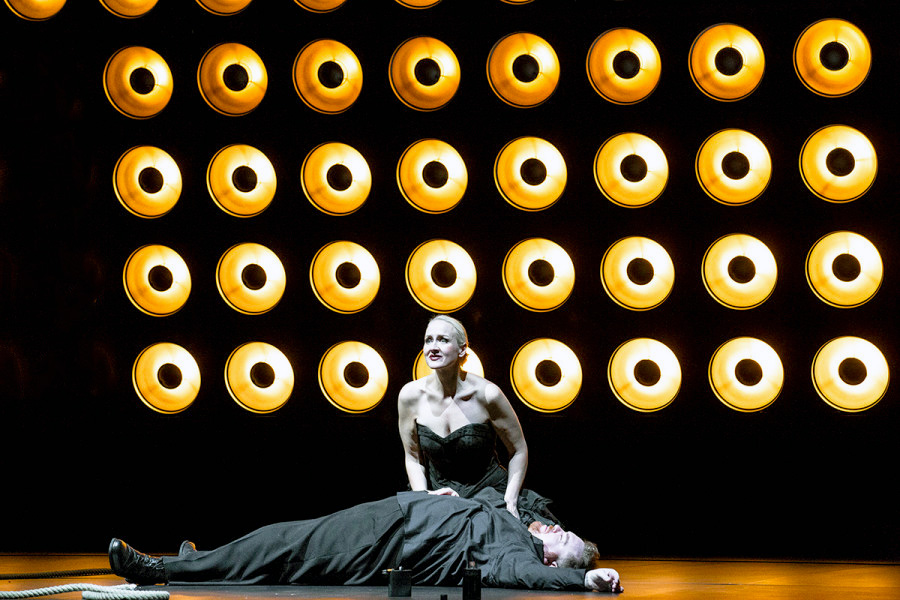
Tristan, Act III: Isolde (Elisabeth Teige) talking to the just deceased Tristan (Clay Hilley) prior to the Liebestod. The main feature of the production is a gigantic tableau with 260 lights. Deutsche Oper Berlin. Photo: © Bernd Uhlig.
Tristan und Isolde at the Deutsche Oper Berlin, which premiered on November 1, 2025, is not entirely new since it is a coproduction with the Grand Théâtre of Geneva and was premiered there in September 2024. Reviews of that premiere were mixed, especially about the production. This reviewer holds that the Berlin production by director Michael Thalheimer is very finely crafted, with the help of an extraordinary cast of singers and musicians.
As the piece virtually demands, Thalheimer reduces the “action” to an absolute minimum of activity on stage: the passions, the waves of pain, of love, of jealousy; all this happens internally, inside the characters. The outer action thus can be reduced to an absolute minimum which, however, only works if the singer-actors on stage are able to express those torrents of passion with their voices, mimics, gestures, and sheer scenic presence. With the cast of the Deutsche Oper, this endeavor succeeded convincingly.
The American tenor Clay Hilley (WSNY’s 2015 Robert Lauch Memorial Fund awardee and 2017 recitalist) is developing into one of the important heldentenors of our age: he does not try to cope with the difficult role of Tristan by force, but by nursing an almost lyrical tone. The sound is radiant, the expression is strong, the interaction with Elisabeth Teige as Isolde gripping, and the way he overcomes the enormous waves of sound ignited by the conductor Sir Donald Runnicles in the third act is stunning. He does so with a strong, albeit lyrical tone based on a firm technical basis that carries him through this devastating act. Elisabeth Teige, as Isolde, is the perfect companion, not only in terms of falling victim to the same absolute passion, but also in the way she interacts with Hilley in the framework of this production. Her voice is brilliant and touching and possesses a huge variety of expressions: both a mesmerising piano betraying a broken and beguiled soul and a fervent, intense forte during the moments of distraught passion. Her intimate dialogue with the just deceased Tristan prior to the Liebestod is deeply moving; the Liebestod itself is sung with fragile beauty, accompanied by a large, slow movement of her arms forming a complete circle until the moment she expires.
At the beginning of the opera Isolde is pulling a gigantic block tied to a long rope across the stage, from right to left. She generally has to bear a heavy burden in life, preventing her from blossoming, even in her passion to Tristan through which she is doomed to fail and doomed to die. The corresponding image is provided at the beginning of Act III, when Tristan, emerging from the dark depths of the back of the stage, is pulling an invisible burden with a long rope. It seems to be a metaphor of affliction, torn between his deadly wound: the social interdiction of his true love and subconscious suffering he has carried with him for his entire life.

Act II: Kng Marke (Georg Zeppenfeld, Melot Dean Murph) and Kurwenal (Thoms Lehman) against a wall of 260 lights. Photo: © Bernd Uhlig.
The main stage feature throughout is a gigantic tableau with 260 lights, symbolizing the öder Tag, Tristan and Isolde’s fiercest enemy. At the same time those round lamps may be seen as eyes, with Tristan and Isolde under constant observation by big brother (in that case, presumably Melot): 260 eyes are watching you. As a consequence, Isolde extinguishes those lights to begin the Liebesnacht in Act II: a stunning effect since the contrast between the blinding glare to soothing darkness is enormous. In Act III, the wall of lights serves as a ceiling and is lowered slowly to a 90 degree angle during Isolde’s Liebestod, gleaming brightly into the audience, yet another mesmerising effect. In this vein the whole set is characterised by minimalistic reduction. And the rest – is acting.The rest of the cast performs equally well. The American mezzo soprano Irene Roberts sings and acts divinely; her Habet acht calls in Act II, sung from the balcony, especially leave a lasting, moving impression. The American baritone Thomas Lehman, an ensemble member of the Deutsche Oper, excels as Kurwenal, endowing Tristan’s servant with the required intensity and warmth of tone. The difficult passage in Act III, feverishly greeting the arrival of Isolde’s shop, is for once beautifully sung, not shouted. Melot, clad in the yellow color of the traitor, is portrayed by Dean Murphy (yet another excellent American singer), torn by jealousy but beautiful in tone.
Then there is Georg Zeppenfeld. He is the Marke, the Gurnemanz of our age, and yet is becoming more and more brilliant and mature. Adding to his superb diction and cultivated tone, he is adding torn, intense, unconditional expression. Fathoming the human depths of melancholy and suffering, he applies this knowledge to Marke’s lament in Act II, reaching a peak in his extraordinary career. Here, he dares to declaim rather than sing certain passages, according to Wagner’s ideal of Sprechgesang, and the heightened dramatic effect is astounding. (Michael Volle is the inventor—and other hero–of this new Wagnerian Sprechgesang of the twenty-first century.)
The “minor roles” are also very well cast: Burkhard Ulrich, long-time member of the ensemble and acclaimed Mime and Loge, sings the Shepherd poignantly and beautifully. Paul Minhyung Roh, a young scholar of the Korean National Opera, endows the Young Sailor with an ethereous yet strong voice. Even the Steersman, sung by Kangyoon Shine Lee, stands out with vigor and determination.
All were well led and guided by maestro Sir Donald Runnicles, who, after 16 successful seasons, will end his term as General Music Director at the Deutsche Oper Berlin. 2024/25 is his farewell season of sorts, in which Runnicles says good bye with pieces that are very dear to his heart, among others: the Ring, which he will conduct in May 2026, and Tristan. The mastery and experience he possesses with this work is palpable, and the orchestra is in splendid form. He does not entirely make use of the enormous dynamic and agogic range that this exceptional score offers and demands, but he knows the score and how to conduct it. In conjunction with the static but captivating production and an excellent cast of singers, this (almost) new Tristan is an important landmark of Wagnerian interpretation today.