
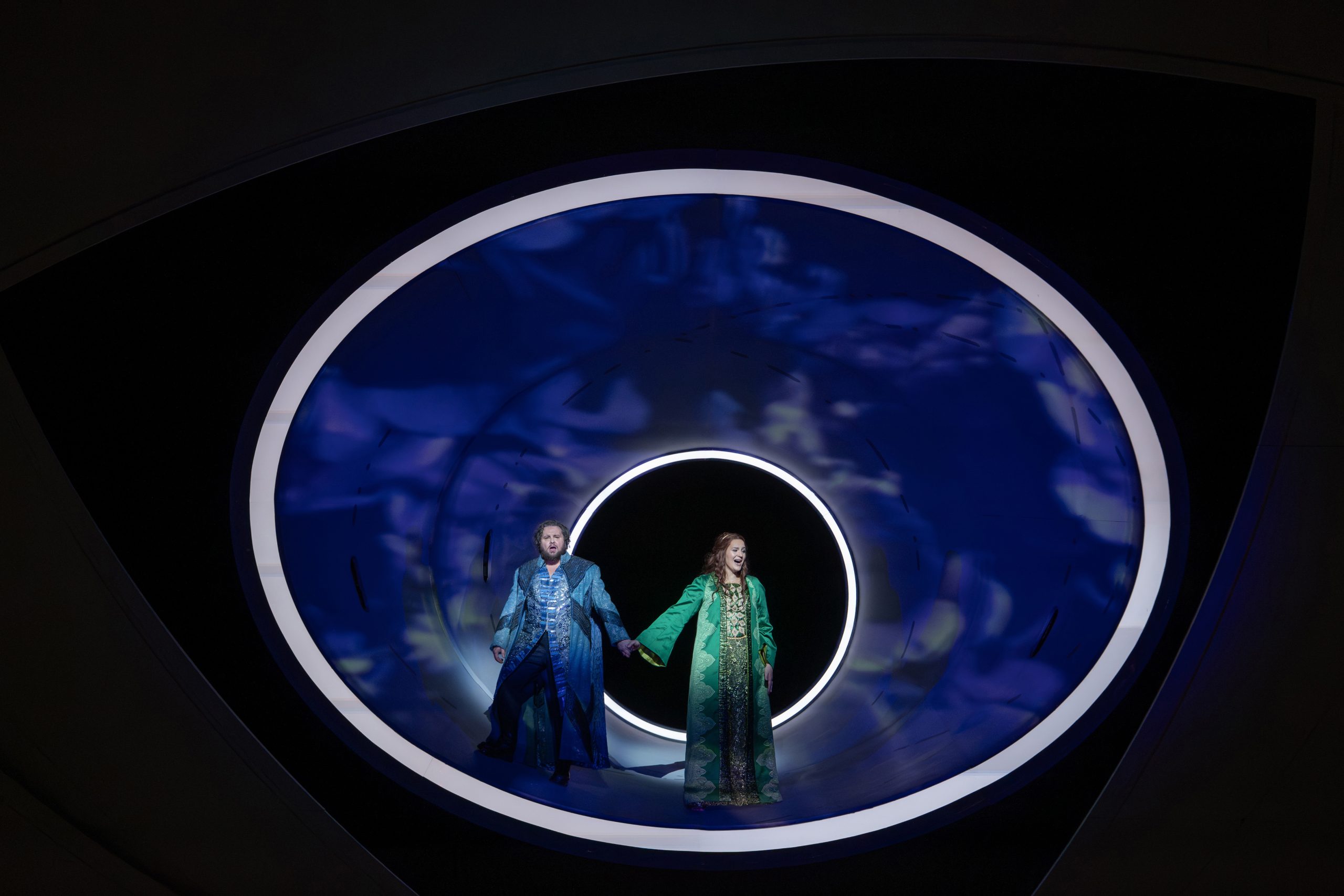
Wagner’s groundbreaking, metaphysical romance Tristan und Isolde returned to the Metropolitan Opera on March 9 for the first time in ten years in a bold new production featuring Lise Davidsen, opera’s current “it” girl. While the promotion focused mainly on Davidsen and Michael Spyres and on the Met directing debut of Yuval Sharon, the rewards came from the efforts of the strong cast, the superb orchestra, and an elaborate production that sometimes overwhelmed the drama.
Sharon’s imagination has never been bound by ordinary limits. He has received many awards, and he was the first American to direct an opera at the Bayreuth Festival, in 2018. As the former artistic director of Michigan Opera Theater (now Detroit Opera), his first production was a Covid-era adaptation of Götterdämmerung staged in a parking garage in Detroit in 2020. Sharon will stage the new Met production of Wagner’s Ring Cycle, beginning with Das Rheingold in 2028. His 2024 book, A New Philosophy of Opera, provides an overview of his thirst for change in the tradition-bound world of opera. His vision for Tristan incorporated more concepts than one evening can handle: his main organizing principle was the duality of, well, everything: death and rebirth, the ritual of the concrete, acted out at a table downstage, versus the fable that plays out in a tunnel floating above the stage.
Es Devlin’s ingenious, monumental set spanned the full area of the proscenium. Functioning as a drop curtain was a panel painted with an asymmetrical iris diaphragm. Midway through the prelude, this panel rose on a small table downstage where a couple sat facing one another: doubles for Tristan and Isolde in modern dress. For the duration of the act, these two actors enacted ritual tasks involving an hourglass, a shared drink, and a dagger. Above and behind the table was a large round disc which opened to reveal a tunnel; most of the singing took place within its walls, which provided some natural amplification to compensate for the acoustical handicap of singing 20 feet above stage level.
From time to time, a portal slid open at the back of the tunnel to reveal a seascape, a sunset, or a row of apothecary vials. Projections covering or surrounding the tunnel included intermittent live video of the action on the downstage table, alternating with moving waves. During the second act duet, the tunnel split into two sections, which drifted slowly right and left as the lovers sang, though they rarely touched (this is one of the few productions that actually has the lovers embrace). The movement tempos of the set and of the actors were dreamlike, with the occasional burst of energy at momentous events like the ship’s arrival in Cornwall or the Melot-Kurwenal sword fight ending Act II.
Clint Ramos dressed the characters in sumptuous robes in rich colors, with stripped-down versions in the same colors for their stage doubles; in the third act the lovers wore paler colors, suggesting the transition to “das Land der Tristan meint.” Lighting by John Torres balanced light and dark and introduced a rainbow of saturated colors, in contrast to the unrelieved murkiness of most Tristan productions; key moments were emphasized with hot white beams of light, a la Robert Wilson. Projections by Jason H. Thompson and video by Ruth Hogben gave depth, motion, and visual interest to an essentially static scenario. Sightlines were good even from my balcony seat, though distance from the stage muted some of the effects. Overall, this production is the most eye-catching Tristan I’ve ever seen, with its live and recorded video of the actors, recurring video wallpaper of water, striking use of color and light, and multiple levels of action.
And that’s the problem: Too much of a good thing becomes a liability. On opening night I found myself briefly ignoring King Marke’s wrenching monologue because I was trying to decipher the live video of a broken dinner plate and purple anemones scattered on the banquet or enjoying the crashing waves that covered the screen surrounding the tunnel. When the screen went blank, I was grateful for a break from the visual distraction. Wagner would never have tolerated anything that robbed attention from his music.
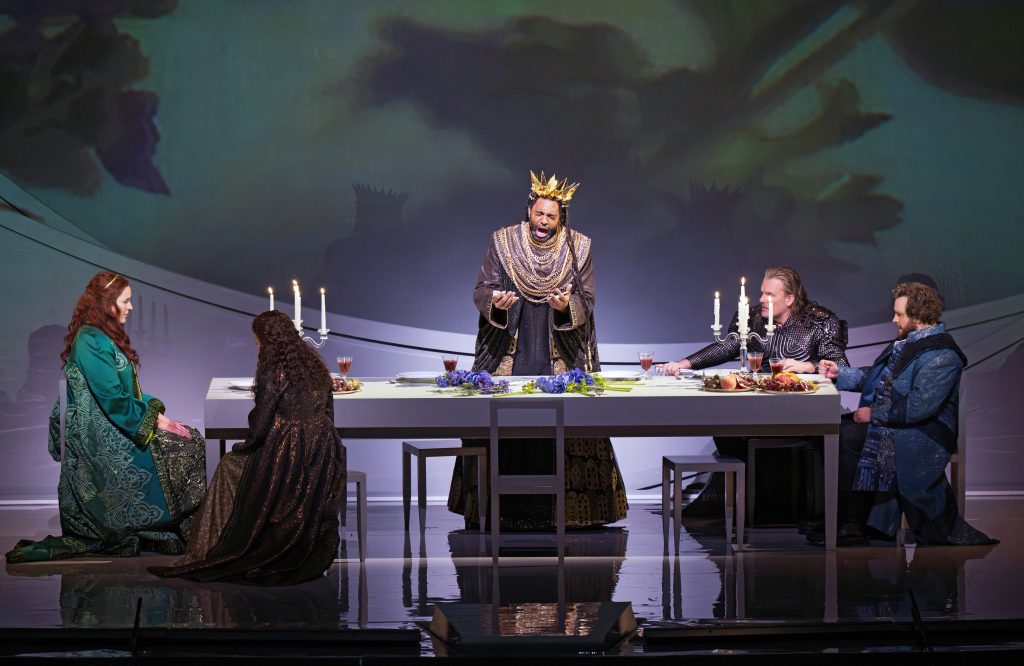
Act II, Left to right: Isolde (Lise Davidsen), Brangäne (Ekaterina Gubanova), King Marke (Ryan Speedo Green), Kurwenal (Tomasz Konieczny) and Tristan (Michael Spyres), as Marke conveys his anger and sadness. Photo: Karen Almond / Met Opera.
Sharon’s more-is-more approach reached its nadir in Act III. The downstage table became a clinic setting; the singing Tristan and Isolde repeatedly switch places with their mute doubles, leaving the stage to reappear in the tunnel overhead which now represents death’s threshold. Downstage, while the actor Tristan lies in agony, attended by Kurwenal and later Isolde, the singing Tristan raves from the tunnel overhead, surrounded by dancers (choreography by Annie-B Parson) who prepare him (and later Isolde) for death. After the Tristan double expires at one end of the table, the Isolde double gives birth at the other end, with the baby ultimately handed to King Marke by Brangane. In the tunnel, Isolde croons the Liebestod as a lullaby before turning to walk into the light at the end of the tunnel.
By the final performance, the production had settled down somewhat. Now familiar with the visual vocabulary, I was able to appreciate the precise coordination of lighting and musical phrases. Substantial stretches of live and recorded video had been eliminated, and they were not missed.
Online responses to the HD screening were mostly positive. The HD was more cinematic, edited to provide many close-ups and eliminate much of the busy background video. The monumental scale had shrunk to human dimensions, but the imagery remained strong.
So after all that, how was the singing? Many had come to hear Isolde sung by Davidsen in her heaviest Wagner role to date. She has become a Met favorite since her 2019 house debut in Queen of Spades. New Yorkers have now heard her in Beethoven, Verdi, Puccini, Strauss, and Wagner; while German seems to be her forte, she will open the next Met season in Verdi’s Macbeth. Davidsen’s voice is a once-in-many-generations phenomenon: cool, steady, amazingly large. Her gleaming laser-like top is her strongest register, but the bottom of her range also projects, and her dramatic engagement has increased. In this production, Isolde dominates physically as well as vocally. Although she relies on her companion, Brangäne, in the first act she bullies Kurwenal and later Tristan, until the Liebestrank, when passion catapults her into new emotional territory. Her vocal acting was most detailed in the first act, but after the opening of the second act she mostly just sang, and on opening night it was glorious. The creamy perfection of her Liebestod, sung as a tender lullaby, didn’t need visible emoting to make its mark.
Michael Spyres made a powerful role debut as Tristan, becoming probably the only singer in history to sing both Nemorino and Tristan in a single season. Spyres chooses his roles to emulate the repertoire of an evolving cast of historic singers as his voice matures. His voice is not as large as Davidsen’s, but his bel canto clarity and focus enabled him to project to the highest reaches of the house. Much of the part lies in his strong baritonal register, but he also rose to the tenorial demands of the role with only a couple of rough high passages. He had admirable endurance in the punishing last act, vividly conveying the dying Tristan’s anguish and unwavering faith that Isolde would return. He also had the best diction of the night. For the April 4th performance, which the Met added after the first few sold-out performances, Stuart Skelton, who is an experienced Tristan, gave a fine, sensitive performance, considering that he had not spent weeks with this demanding production.
Ryan Speedo Green’s first-ever King Marke was sonorous and imbued with dignity and sorrow. The staging rendered his first entrance puzzlingly low-key: Instead of bursting in on the lovers singing overhead, he quietly took his place at the banquet table, with his back to the audience. I enjoyed more the final (April 4th) performance’s Marke, Steven Milling. His experience showed in the nuance and gravitas that Green has yet to develop.
Ekaterina Gubanova returned as Brangäne, which she had sung in the Met’s 2016 Trelinski production. Her voice shows audible wear since 2016, and the staging often required her to sing behind a scrim. But she played a good companion to her Isolde, her mezzo-soprano sounding girlish next to Davidsen’s more womanly sound.
Tomasz Konieczny was raw and blustery in the first act, but by the third act he had mellowed dramatically and vocally into a sympathetic Kurwenal. Both timbre and interpretation became more settled during the run. Ben Reisinger as the Sailor, singing from the balcony, sounded both fresh and stentorian. Thomas Glass’ Melot had fine vocal and theatrical presence, though with more vibrato than expected in a young baritone. In his Met debut, Steersman Ben Brady sang sweetly, with a hint of a heldentenor future.
Music director Yannick Nézet-Séguin utilized spacious tempos, allowing the music’s energy to surge and subside, and highlighting smaller wind and brass solos. At times, the Met Orchestra overpowered the singers, a tendency often noted with this conductor and noted especially in the final performance. But even with the staging challenges, vocal-instrumental balances were not overly problematic. English horn soloist Pedro R. Díaz played beautifully, costumed in numinous white, sharing the tunnel-stage with Tristan in the third act.