
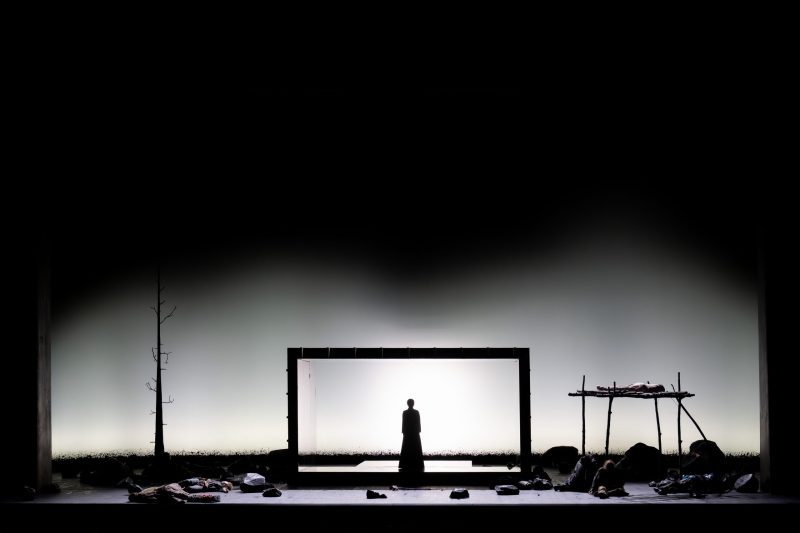
Two events that occurred in Pierre Audi’s life on July 20, 1969–attending Tristan und Isolde in Munich and watching Neil Armstrong set foot on the moon–would heavily influence the lunar metaphor in his 2016 production of Tristan at the Theatre des Champs-Élysées in Paris and at the Teatro dell-Opera di Roma. The Dutch National Opera premiere took place in 2018–with Stephen Gould as Tristan, and the revival premiere, on Feb. 8, 2026. [Audi’s life and untimely death, at age 67, were reported in the July 2025 issue.]
Audi’s Tristan began in complete darkness, as the Rotterdam Philharmonic, under the baton of the 25-year old Finnish conductor Tarmo Peltokoski, gently unwound Wagner’s endless melody. The leads slowly emerged on stage, silhouetted in a stark chiaroscuro by lighting designer Jean Kalman. The prelude and shadow play concluded as Isolde, Swedish soprano Malin Byström, knife in hand, failed to kill Tristan, Swedish baritone Michael Weinius. The towering set structures of Christof Hetzer’s stage design then moved into place.
The first act was staged in an oil tanker; Audi’s direction, now overseen by Lisenka Heijboer Castañón and Frans Willem de Haas in revival, did not utilize the nautical aesthetics and idiom traditionally associated with Tristan. The Steersman’s call echoed through rust rather than ocean. The passage to Cornwall and Kareol’s shores was transformed into the moon’s “sea of tranquility.” Even the fluid potions of love and death were petrified, represented by two types of moonrock: a crystalline Liebestrank and an obsidian Todestrank.
Each succeeding act became more subdued, with the Liebesnacht occurring in a forest of old bones and the inky cairn of the Todestrank stone, with the finale unfolding in a wasteland containing broken pieces of the stone scattered around the stage; the finale unfolded in a wasteland containing broken pieces of the stone scattered around the stage. During the Liebestod, the chiaroscuro returned; Isolde, obscured by shadow, became the only detectable being in a stage now overwhelmed by mortal light. This stripped dimension provided a fascinating space, where highest passion was not just cosmic unity but the peaceful silence of the lovers resting their heads together, as was typical in Audi’s productions. A few dramatic choices diminished the effectiveness of Audi’s vision, the most egregious being a black square which took various forms over the three acts, adding an unnecessary element of abstract style over directorial substance.
The human elements of the production provided a foil to the contemplative stillness of Audi’s staging. Byström was a youthful, powerful Isolde. In a dramatic performance, she enthralled the audience for the first two acts. By the third act, her voice had noticeably declined, but she ultimately succeeded in a performance that would become a stunning role debut.
Michael Weinius’ grounded Tristan complemented Byström’s approach, balancing shame and sensitivity. Supporting the leads, American baritone Jordan Shanahan’s sharp Kurwenal was well acted and sung. The American mezzo-soprano Irene Roberts was a standout as Brangäne, bringing a youthful, sisterly approach to her vocal and dramatic presence. The Chinese bass Liang Li was a cool King Marke.
Providing the critical musical architecture, Peltokoski led the Rotterdam Philharmonic in an intimate interpretation of the score. (He has said that Tristan is the most beautiful work of art in the world.) His ability to balance gentle, reserved tension with oneiric sensuality created a sonic dimension that perfectly complemented Audi’s staging.
This 2026 revival, with amazing singing and thought-provoking direction, received a storm of applause, particularly when the portrait of Audi was projected in a black frame. He left behind a dramatic and Wagnerian legacy, particularly in Amsterdam, where he led the Dutch National Opera as artistic director for 30 years. It is both a reflective memorial and an exciting testament to the future of Dutch opera production.