
The Atlanta Opera’s recent performances of Götterdämmerung (May 30; June 2, 6, and 7) marked the capstone of a Ring project that formally began with Das Rheingold in 2023, though its origins reach back much further. When Israeli-born Tomer Zvulun spoke to the Wagner Society of Santa Fe last summer, he described a vision that had taken shape over more than a decade. Upon his arrival in Atlanta in 2013, he set two goals: to transform the company from a regional company into one of national, even international stature, and—once that foundation had been laid—to mount a Ring cycle, the quintessential international operatic event. That ambition will be fully realized in 2029, and it is not difficult to imagine Wagnerians from New York and beyond making their pilgrimage to Atlanta. Zvulun previously worked at Seattle Opera for several years, with Speight Jenkins as a mentor. These performances were dedicated to Jenkins, who died May 20, 2026.
Götterdämmerung remains Wagner’s most problematic opera, and for reasons largely inherent in its genesis. The libretto was conceived decades before the music, leaving Wagner to set a text rooted in Lohengrin-era dramaturgy—complete with an Act II chorus—but using a musical and philosophical language that had evolved far beyond it. The ideological shift during this gestation period is just as striking: from Feuerbach to Schopenhauer, from revolutionary optimism to metaphysical resignation.
The original conception, Siegfrieds Tod, emerged from Wagner’s Dresden years, steeped in revolutionary fervor. In that earlier vision, corruption and materialism would be overcome through love; the Nibelungs would be freed; gods and humanity alike would be purified without annihilation. Wotan would endure, presiding over a redeemed world, with Siegfried as a figure of salvation—akin to Lohengrin, even to Parsifal. Siegfried’s purpose, in this conception, was nothing less than the redemption of the gods.
By 1876, however, that vision had darkened. The Bayreuth Götterdämmerung is less about heroism than about treachery, manipulation, and collapse. This duality of two different visions creates a structural problem: how to justify Brünnhilde’s apotheosis of Siegfried as a hero when, in this opera, he had scarcely acted as one. Wagner’s solution was musical rather than textual. “Siegfried’s Funeral Music,” which precedes the final scene, constructs a retrospective heroism never actually seen: it is a sonic biography assembled from leitmotivic memory — the Volsung lineage, the love of Siegmund and Sieglinde, the sword, the youthful hero, and Brünnhilde’s love. Only then could the Immolation Scene proceed with emotional credibility.
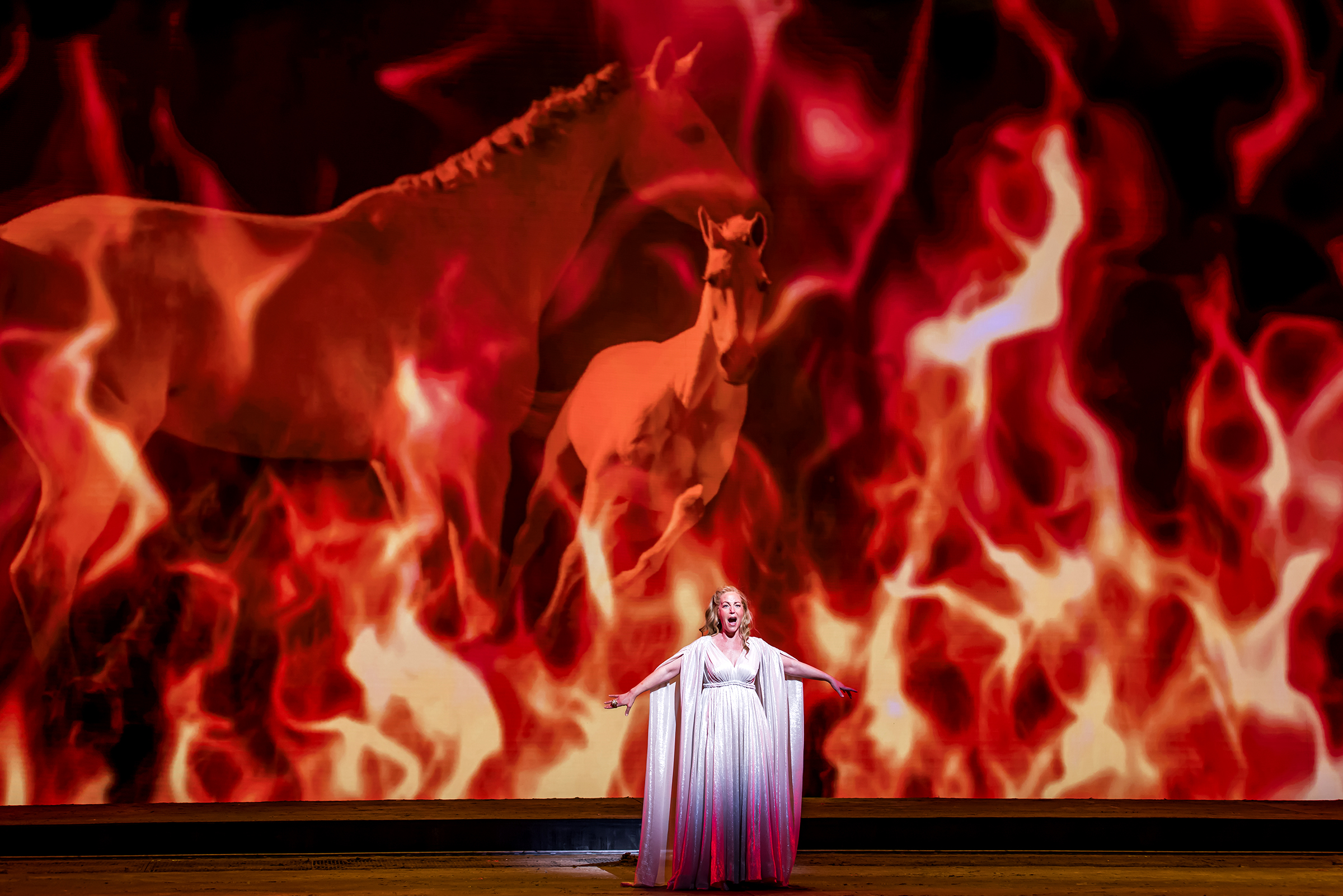
Zvulun, who serves as both general and artistic director as well as stage director of Atlanta Opera, balances fidelity to Wagner’s stage directions with a strikingly modern visual language. His use of video and projection is not decorative but dramaturgical. With the brutalist architectural aesthetic (bréton brut) of the Gibichung world, the heavy, block structures with their hard edges and intentional sense of weight, designed by Erhard Rom, finally collapse to the fiery ground.
The Ring has always possessed a proto-cinematic quality, and Zvulun realizes it with unusual fluency. The Immolation Scene in particular achieves a rare synthesis of musical, visual, and symbolic elements; even Grane appears, as Wagner specifies but is often omitted. Zvulun’s background in multimedia is evident here, and he makes a compelling case for the future of opera as an integrated visual and musical form.
Musically, the performance was consistently strong. The orchestra, under Roberto Kalb, played favorably at a level alongside many European opera orchestras. Kalb’s conducting allowed the drama to unfold with natural momentum. The horns showed some fatigue at the close, a minor blemish. The chorus, prepared by Walter Huff, was exemplary in projection, diction, and intonation.
I had reviewed the Oct. 2025 Staatsoper unter den Linden’s Ring Cycle (Thielemann/Tcherniakov) in these pages and cannot avoid making comparisons. That production boasted a more illustrious cast but was undermined by incoherent staging. In Atlanta, the opposite held true: a strong but not starry ensemble, elevated by first-rate theatrical realization.
Lise Lindstrom’s Brünnhilde combined intensity with vulnerability. After a somewhat restrained Act I, she rose to full stature in Act II and delivered a compelling Immolation Scene. Stefan Vinke as Siegfried sang with direct, unforced tone and a secure upper register. Particularly notable was Le Bu’s Gunther (a Met Lindemann Artist alumnus), in a sharply characterized portrayal that, together with Sylvia d’Amaro’s unusually vivid Gutrune, rendered the Gibichung siblings a genuinely menacing pair. David Leigh (a 2017 WSNY awardee) as Hagen brought solid vocal weight and effective stage presence, though with some limitations at the top. Aleksey Bogdanov was an excellent Alberich. Tamara Mumford’s Waltraute was deeply felt, especially in conveying Wotan’s quiet despair. She was also First Norn, with second and third Norns Olivia Vote and Caitlin Lynch in effective performances.
Atlanta is fortunate to have a leader of Zvulun’s vision and capability, and he has already transformed the company’s scale and ambition. If this Götterdämmerung is any indication, the 2029 Ring cycle will not merely fulfill a long-held goal but establish Atlanta as a major destination for Wagner performance.