
Until relatively recently, productions of the Ring Cycle were restricted almost entirely to the largest opera companies which had the financial resources, stage facilities, and pit size needed for such a monumental undertaking. It can be daunting and has bankrupted more companies than any other operatic adventure. In the past few decades, however, Rings have been popping up in unlikely smaller locations, generally using score versions for reduced orchestra and often benefiting from modern video technology, which eliminates the need for elaborate stage machinery and multiple extensive sets. As opera companies have scaled back on much of the repertoire, Wagner has been one of
Sofia Opera and Ballet, whose house seats 1000, would have seemed an implausible Ring site if only because of the daunting cost per seat. Until 2009, the company had almost no experience with Wagner for political reasons: the Communist government had prohibited Wagner due to his appropriation by the Nazis. Democracy and the end of Soviet control occurred in 1990. Then, in 1994, Plamen Kartaloff, a charismatic professor, stage director, and committed Wagnerite, became General Director of the company. Starting with a concert version of Lohengrin in 2009, Kartaloff proceeded to build the company into “the Bayreuth of the Balkans,” introducing its first full Ring Cycle in 2013. That production appeared regularly in Sofia, toured elsewhere, including to Moscow, and turned Sofia into a destination for the Wagner cult. In 2023, it was replaced by a new production, which was repeated in 2024 and 2025 and again this season for a single cycle.
Wagnerites are fiercely divided between the modernists, who favor productions built around allegory, often with an overarching concept, and the literalists, who want to see the whole panoply of gods, monsters, and magic portrayed onstage with minimal context. Kartaloff’s production (he is stage director for all operas here), definitely falls into the latter camp. He noted: “When the director follows the inner logic of the score and drama, he gives the audience the opportunity to inadvertently meet Wagner, not the director’s interpretation of himself.” His production is not without symbolism, however. Unlike most newer Rings, he uses video projections only for background, favoring abstract sets and a range of fantasy costumes.
Austrian stage designer Hans Kudlich’s sets used a triskelion as the base design for the entire cycle, with large raised geometric designs shaped vaguely like the letter “a.” These pods, which evoked ancient Celtic and Greek mythology, were displayed in various configurations and angles throughout the cycle. Kartaloff has referred to them as depicting the spiral of life, from birth to greatness to death and regeneration, perhaps the ultimate metaphor for the Ring. Valhalla was represented by a shiny, rather gaudy frame which could suggest a building, a spear, or a phallus. Other set elements included metal cages for Niebelheim (inside are Nibelungs who can strike anvils), a tentlike structure for Hunding’s hut, and a metal box frame for Mime. Lighting, by Andrej Hajdinjak, and background video projections worked together to make this a vividly colorful production.
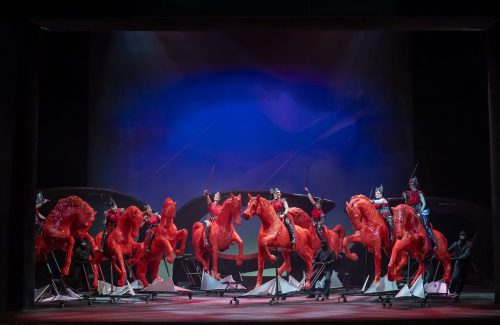
Costumes, by Hristiyana Mihaleva-Zorbalieva, ran the gamut. Das Rheingold sometimes resembled a Halloween party, as the gods paraded around in uniforms that might have been borrowed from a Star Wars sequel (Freia’s frilly extravaganza of a gown, with apples attached, deserves special mention) and the Rhinemaidens swam around and bounced on trampolines in sparkly swimsuits. Wotan got a variety of colorful leather robes, and most of the men got simpler leather jackets that suggested ancient warriors. Siegfried wore blue jeans and a fancy leather jacket with a large red metallic epaulet, resembling a bird’s wing, on one side. Sieglinde and Gutrune wore elegant gowns, and the Valkyries, red armor and helmets.
Speaking of Valkyries, the most memorable scenic device in this production was the use of bright red, life-size horses for each of the Valkyries to ride, propelled on wheels by black-clad handlers. Another novelty was the Forest Bird (Maria Pavlova) literally flying above the stage, like Peter Pan, suspended by elastic straps so that she could move up and down and sideways as she sang. The dragon’s head was only seen in a cartoonish version whose mouth opened to reveal sharp teeth.
One recurring feature was the appearance in the background of characters who were being recalled in the dialogue. For example, during Wotan’s Act II monologue in Die Walküre, we saw Erda and then the warrior heroes and Alberich appear silently backstage. And Wotan showed up for the final scene of Götterdämmerung.
As the Siegfried overture played, we watched Sieglinde giving birth to Siegfried, aided by Mime, and we then saw Mime chasing a small boy, then an older boy, then a teenager – depicting their years together prior to the first scene.
The Immolation Scene that concludes Götterdämmerung was mesmerizing. We watched Valhalla collapse, with an evocative display of conflagration and flooding.
One distinctive feature of this production is the reliance on an almost entirely Bulgarian cast: only three singers in the vast Ring cast were from elsewhere, and it clearly is part of an effort to foster Bulgarian singers. Kartaloff stated: “The Bulgarian singers possess the necessary vocal and dramatic potential to perform Wagner and they prove it on stage. What’s more important is they work in a joint artistic environment with a shared style and theatrical thinking which gives the performance entirety, an organic feeling, and inner connectedness.” This worked surprisingly well, aided considerably by the intimate size and resonant acoustics of this theater, a boon to smaller voices.
The role of Wotan/Wanderer was triple-cast. In Das Rheingold, Veselin Mihaylov had a distinct baritonal sound and was dramatically secure, though the voice seemed too small to sing these roles in larger houses. For Die Walküre, Greek bass-baritone Aris Argiris dominated the stage with a distinctive, handsome dark-hued voice and regal bearing, revealing the full range of his character’s emotions. Krisztián Cser portrayed the Wanderer in Siegfried. His dark voice has a rich timber; a charismatic actor, he brought a sense of nobility, dignity, and serenity to his character.
Brünnhilde was portrayed by two singers. In Die Walküre, Gergana Rusekova displayed an attractive voice with a nice timbre, but she was dramatically inert and static. In Siegfried and Götterdämmerung, Radostina Nikolaeva’s lyric-spinto soprano proved capable of expressing the full range of emotions; although sometimes covered by the orchestra, her sharp, incisive top notes were thrilling.
With a powerful, rustic voice, Plamen Dimitrov portrayed Alberich as a dark and malignant force. As Loge, Daniel Ostretsov was a vocal and dramatic delight, prancing and dancing with wry, winking expressions. Krassimir Dinev’s Mime had just enough of a whiny, nasal sound to delineate his character without falling into caricature, with his powerful voice and kinetic portrayal.
Vesela Yaneva was an especially interesting Fricka, determined and frigid rather than nagging, with a resonant mezzo voice. She doubled as Schwertleite. Violetta Vladomirska was a commanding Erda in Das Rheingold. Her dark contralto voice has a supernatural quality ideal for the role. For Siegfried, Erda was portrayed by Yaneva.
Martin Iliev was a fierce, combative Siegmund, returning as Siegfried, boyishly energetic in Siegfried, then more noble in Götterdämmerung . The voice is powerful and biting, without much subtlety or dynamic range, with significant vibrato and occasional intonation issues. As Sieglinde, Alma Liza Bandalovska displayed a lovely voice with a secure top, although somewhat underpowered in the middle and lower range. Austrian bass Kurt Rydl, with a huge voice and riveting at age 78, was a gripping, malevolent force as Hunding. Atanas Mladenov portrayed Gunther as shy and distracted. An excellent actor, his baritone voice was precise and expressive. Bandalovska returned as Gutrune, artfully expressing the contradictions in her character. Petar Buchkov sang as Fafner, then returned as Hagen. In both cases, he used his deep, resonant bass voice to dramatic effect.
German conductor Constantin Trinks is a veteran Wagner conductor who understands how to shape the Ring score, punching up the variations in tempi and dynamics, sometimes at the expense of the singers. In spite of occasional brass errors and minor problems with string tone, this was a thrilling performance of the score by the 80 musicians.
Bulgaria is a small country and not a wealthy one, but its musical tradition is a source of pride: it has a history of producing great singers like Boris Christoff, Ghena Dimitrova, and Sonya Yoncheva. Kartaloff uses his compact jewel of an opera house as a showcase for the current generation of Bulgarian singers, and his intelligently staged Ring is a worthy destination for Wagner fans worldwide. This season’s Wagner Festival continued with Lohengrin on June 12 and Tannhäuser on June 14, each for a single performance.
The 2027 festival has been announced: Ring cycle: June 26, 27, 29, July 2; Meistersinger: May 28, 30, July 3. For further information, go to https://www.operasofia.bg/en