
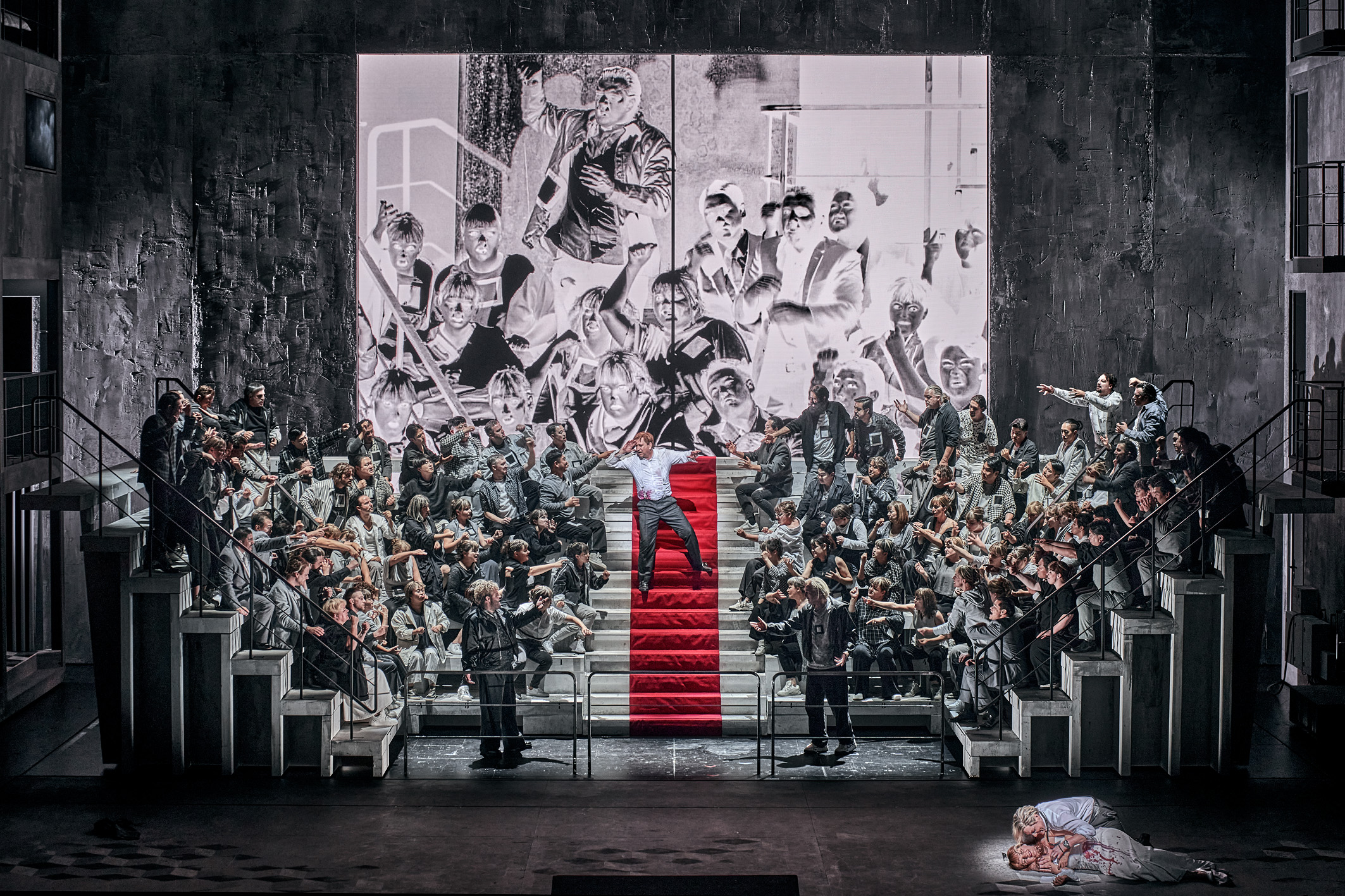
The centerpiece of Bayreuth’s 150th-anniversary season was the first performance ever of Richard Wagner’s “youth work” Rienzi in the Festspielhaus. Rienzi has never belonged to the traditional ten-work Bayreuth canon, so staging Wagner’s only grand opera on the Green Hill was a genuine experiment.
Since 2026 marks 150 years since the first Bayreuth Festival of August 1876, the opening days carried extra weight. A ceremonial Festakt opened the festival on July 25, the traditional inauguration date, with remarks from Chancellor Friedrich Merz and Bavarian Minister-President Markus Söder; the keynote was given by Nike Wagner, who spoke about the festival’s history and her own experience with it. Christian Thielemann conducted the Festival Orchestra in excerpts from Meistersinger and Tannhäuser and in Beethoven’s Ninth Symphony. His conducting was, uncharacteristically, sloppy and uninspired; only in the finale did he find his grip, producing real dramatic tension and an enthralling range of dynamics and tempo. The next morning brought a memorial event, “Verstummte Stimmen” (Silenced Voices), with author Michel Friedman as guest of honor, who received sustained applause.
The third inaugural event was the premiere itself, on July 26. The opera is better than its reputation suggests. What stands out, especially against the truncated versions heard in recent decades, is its completeness: a work “Wagnerian from beginning to end,” as Egon Voss put it, already carrying many of the composer’s signature traits. Choral scenes recall Tannhäuser, ensembles anticipate Lohengrin, and Wagner’s personal voice is unmistakable. Yet the leap from Rienzi, finished in Paris in November 1840, to Der Fliegende Holländer, begun there in June 1841, is enormous: continuous dramatic evolution replaced a sequence of numbers, and the first hints of a leitmotif system appeared.
Rienzi‘s roots in the German Vormärz period (1815-1848) are unmistakable. The opera conveyed the hopes of Wagner’s generation to overcome political fragmentation and forge a unified, liberal nation, a root that Hitler and Nazi Germany misread almost beyond belief. Interestingly enough, in fascist Italy, the opera’s brutal ending made it something of a taboo, while Hitler romanticised it as a metaphor of his own rise to power. At the end of the fascist period, Mussolini was publicly hanged in April 1945, much as Cola di Rienzo was lynched in Rome in 1354, and Hitler killed himself two days later amid the burning of his capital, just as Rienzi dies in flames atop the Capitol at the opera’s end.
Staging the opera meant first solving the problem of the version: Wagner never fixed a final score. As was customary in the 1830s, he composed more music than any single performance would use, and while he settled on a final text in 1871, he never finalized the score itself. The original manuscript, given to Hitler for his fiftieth birthday in 1939 along with several other autographs, vanished in the final weeks of World War II and has never resurfaced. Dramaturg Markus Kiesel spent three years building a thorough, well-balanced version across the opera’s five acts. Productions of Rienzi are usually cut beyond recognition, as at Deutsche Oper Berlin in 2010, which trimmed the work to two hours and left its tenor shouting almost without pause. The 2026 Bayreuth version is far better proportioned, though the role remains punishing, demanding careful vocal husbandry from any tenor hoping to last the night intact.
Andreas Schager met the title role’s demands admirably, sustaining true heldentenor stamina throughout; only in exposed piano passages, such as the prayer “Allmächtiger Vater” (oddly relocated from Act V to the start of Act IV, where it makes little dramatic sense), did small cracks appear in his otherwise radiant voice. The men generally outsang the women. Secondary male roles were excellently cast, and Michael Nagy and Andreas Bauer Kannabas, as heads of the rival Orsini and Colonna families, stood out; Bauer Kannabas impressed both vocally and physically, not least in a striking staged fall after his execution in Act III. The women faced tougher going: Gabriela Scherer, as Rienzi’s sister Irene, is a lyric soprano who often had to push past her natural range, while Jennifer Holloway, as her lover Adriano, has the more dramatic instrument but had heavy vibrato and a sharp tone in her upper register.
Directors Alexandra Szemerédy and Magdolna Parditka relocated the story to a present-day setting of social-media populism, a persuasive translation of Wagner’s metaphor about the rise and fall of “the last of the tribunes.” The concept worked especially well in the first two acts, with Rienzi’s rise in the polls tracked through cell phone messages from “the people” displayed on large screens, building to his election victory and a failed assassination attempt closing Act II. The most striking touch came in the ballet music and pantomime Wagner wrote to depict the rape of Lucretia and Rome’s salvation through Brutus, but was cut before the 1842 Dresden premiere. The directors used it to build a stage within the stage resembling the Festspielhaus itself, with a golden miniature Wagner presiding over scenes from his later operas, told through simple Baroque-style props, balancing seriousness with real theatrical wit. However, from Act III onward, the staging grows shallow and repetitive; it avoids the cheap Hitler-Mussolini parallel that undid the Deutsche Oper Berlin production, but loses focus, ending with Rienzi climbing a staircase to heaven and dying at the top on the opera’s final bars.
The music itself was superbly led by Nathalie Stutzmann, who had problems with balance and coordination conducting Tannhäuser at Bayreuth in 2023 and 2024. Here she commanded the sprawling score with real authority, shaping its architecture while letting it shine, drawing a rich orchestral palette and masterful control in its most explosive moments. The one shortfall was the chorus which lacked its usual precision and blend. While Rienzi is a work that even experienced Wagner singers have to learn and thus deserves some allowances, the loss of excellence in classic choral works such as Parsifal and Holländer, in comparison to the years prior to the big chorus reshuffle in 2024/25, was blatant. The old ultra precision and awe-inspiring homogeneity is no more. The reasons for this self-mutilation with regards to the exceptional status of the Bayreuth chorus on a global scale remain a big mystery.
As for Rienzi, the biggest surprise was how naturally the score fit the Festspielhaus, as if it had been performed there for decades. It reaches the same acoustic limits, in clarity and instrumental radiance, as Tannhäuser, Meistersinger, or even Tristan, none of which were written for this house either. On musical grounds alone, it is a shame this experiment is confined to a single season rather than letting the directors refine the production under near-ideal conditions, in the “Bayreuth workshop” tradition.